India-Japan Defence: The Rhetoric Is Great. The Partnership Needs to Catch Up
Japan's Defence Minister Shinjiro Koizumi is in Delhi this week at a moment of historic Japanese transformation, when Tokyo is finally treating military power, defence exports and security assistance as normal instruments of statecraft. C. Raja Mohan argues the visit should end incrementalism and push India and Japan toward real joint development, co-production and operational coordination. The shared China challenge and the volatility of American policy, he writes, no longer allow the comfortable gap between the rhetoric of the 'Special Strategic and Global Partnership' and the reality of defence cooperation.
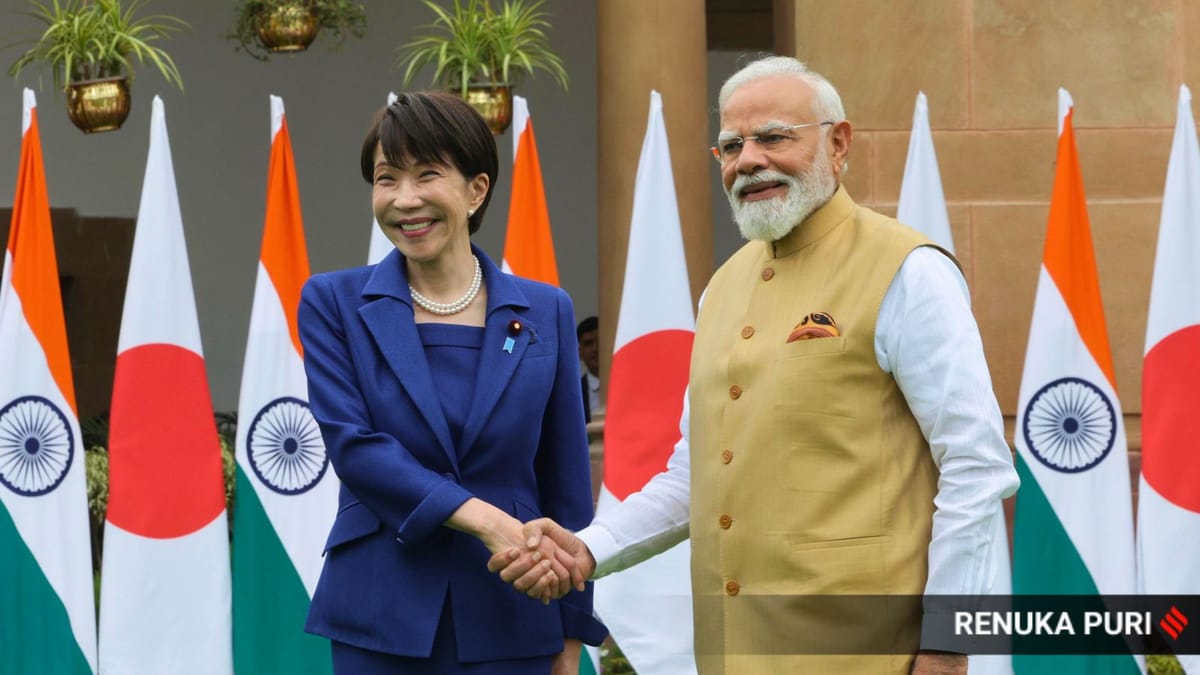
Japan's Defence Minister Shinjiro Koizumi lands in New Delhi this week carrying something more consequential than a routine bilateral agenda: the promise of a Japan that has quietly shed its postwar reluctance to treat military power as a normal instrument of statecraft. The obvious reading of the visit is that it is another high-level exchange between two countries that talk a great deal about their 'Special Strategic and Global Partnership'. The harder question, pressed by C. Raja Mohan in his Indian Express column of August 18, is whether Delhi will use the occasion to move the partnership from comfortable rhetoric to real operational and technological weight. The China challenge the two capitals share, and the volatility of American politics that magnifies it, no longer permit the slow, incremental approach of the past.
What is the state of India-Japan defence cooperation in 2026?
Rhetorical: strong. Operational: thin. Defence Minister Shinjiro Koizumi’s August 2026 Delhi visit reflects Japan’s shift to normal military statecraft (2% of GDP spending, Tomahawk missiles, weapons exports), but bilateral defence trade, tech transfer and joint capability programmes with India remain modest against the China challenge both share.
The Story in 60 Seconds
What Actually Happened?
Japanese Defence Minister Shinjiro Koizumi is scheduled to meet India's Defence Minister Rajnath Singh in New Delhi on August 20, 2026, on a visit that follows the eighth India-Japan Defence Policy Dialogue held in Tokyo on July 13 and comes ahead of a 2+2 ministerial dialogue expected later this year. The visit is part of a two-nation tour that also takes Koizumi to Australia, and he inspected the Indian Navy's Western Naval Command in Mumbai before arriving in the capital.
The agenda reflects a deepening relationship. Japanese media, citing officials of Japan's Defence Ministry, report that the ministers are expected to discuss cooperation on defence equipment, including the export of the UNICORN naval communication antenna system to India, an expansion of joint exercises between the Self-Defense Forces and the Indian military, and the situation in the Indo-Pacific, including China's activities. India and Japan already have the institutional architecture in place: a 2+2 dialogue, the Acquisition and Cross-Servicing Agreement signed in September 2020, and regular exercises across all three services.
Raja Mohan reads the visit as an occasion that should end the 'slow and incremental approaches' to India-Japan defence cooperation and outline more ambitious goals. The partnership, he argues, has expanded but remains well behind the political rhetoric about the 'Special Strategic and Global Partnership'. The gap is widest in defence industry: joint research, development and co-production have moved painfully slowly, and the armed forces still need to move beyond exercising together toward greater operational coordination.
What the visit will actually deliver is not yet known. Analysts note the difference between export approval for a Japanese system and a genuine co-production arrangement, which is what would matter most for India's defence industrial ambitions. Whether the talks translate into funded programmes, contracts and operational commitments, or remain at the level of expanded exercises and political statements, will become clear only in the weeks after the meeting.
- Visit: Japan's Defence Minister Shinjiro Koizumi meets India's Defence Minister Rajnath Singh in New Delhi.
- Agenda: talks centre on defence equipment, co-production and a stronger security partnership.
- Reading: Raja Mohan calls for ending the slow, incremental approach to India-Japan defence ties.
- Unknown: what the visit will actually deliver is not yet clear; approvals and concrete deals remain pending.
The timing of the visit is itself meaningful. Koizumi comes to Delhi weeks after Prime Minister Sanae Takaichi's own visit, on the heels of the eighth Defence Policy Dialogue in Tokyo, and ahead of a 2+2 ministerial dialogue scheduled for later this year. Three high-level touchpoints in rapid succession suggest that both governments are aware that the political moment is favourable. What is at stake in this visit, therefore, is not whether the relationship will grow, which is assumed, but whether it grows at the pace and depth the strategic environment now demands.
The Shared Challenge: The Same Method, Different Geography
The strategic logic of the partnership begins with what Delhi and Tokyo have in common. Both confront assertive Chinese military policies, but on very different fronts: Japan faces China on its maritime frontier in the East China Sea and beyond, while India faces it along a contested land border across the Himalayas. The geography is different, but the method of the People's Liberation Army, in Raja Mohan's telling, is the same: persistent probing and the slow but definitive alteration of the territorial status quo. Neither country experiences a single dramatic breach; both experience a continuous, grinding pressure that is designed to normalise new facts on the ground.
Japanese Investment Sectors
| Theatre | Where the pressure comes | The PLA's method |
|---|---|---|
| Japan's maritime frontier | East China Sea, Senkaku/Diaoyu islands, and the broader first-island chain | Coercive patrols, incursions into territorial waters, airspace probes and slow militarisation of contested features |
| India's Himalayan border | Line of Actual Control (LAC) across Ladakh, Uttarakhand, Sikkim and Arunachal Pradesh | Border incursions, massed deployments, infrastructure build-up and negotiated changes in the status quo, as seen in the 2020 Galwan standoff |
| The shared pattern | Two fronts of the same competition | Neither relies on a single big war; both work through persistent probing that is hard to answer without escalation |
The Volatility of American Power
The China challenge is magnified, in both capitals, by the volatility of American policy. Neither Delhi nor Tokyo seeks an Asia without the United States. Japan remains deeply invested in its alliance with Washington, and India continues to see an American military presence as essential to a stable Asian balance. But Donald Trump's second presidency, Raja Mohan writes, has reinforced questions about the predictability of American policy and the nature of its regional commitments. For two countries that have long operated in the shadow of American power, this uncertainty is not an abstraction. It is the reason the response to China cannot be built entirely on hope that Washington will act predictably. Part of the answer, he argues, lies in strengthening national capabilities and deepening partnerships with each other and with other Asian powers.
This is where the two countries' paths converge. Japan cannot simply deepen its reliance on an ally whose commitments it can no longer take for granted, and India has never been willing to outsource its security to any great power. Both therefore face the same strategic problem in different vocabularies: how to build enough independent and joint capability that a crisis with China does not force an unwelcome choice between escalation and capitulation. The logical answer is a denser web of cooperation among Asian powers who share the same worry, and for Delhi the most natural partner on this list is Tokyo, a major economy, a democratic state and a resident naval power in the Indo-Pacific.
How Did We Get Here?
Japan's transformation has been building for more than a decade, and its pace has accelerated sharply in the last three years. The timeline below traces the key turns from economic rival to re-armed power.
- 2010 China overtakes Japan as the world's second-largest economy, giving Beijing the economic resources to fund a massive expansion of military capabilities.
- 2012 Shinzo Abe returns as prime minister and begins the deliberate adaptation of Japanese security policy to the new circumstances.
- Sept 2020 India and Japan sign the Acquisition and Cross-Servicing Agreement (ACSA), allowing reciprocal logistics support between the two militaries.
- 2022 Japan adopts a sweeping set of defence reforms: a target of about 2% of GDP for defence spending by 2027, a new counterstrike doctrine, and a Defence Buildup Programme worth roughly 43 trillion yen.
- Nov 2024 India and Japan sign a Memorandum of Implementation in Tokyo for co-developing the UNICORN naval antenna mast for Indian Navy ships.
- Aug 2025 Australia selects Japan's Mogami-class frigate design for its future fleet, an 11-ship programme worth about AUD 10 billion, Japan's largest defence export since World War II.
- July 2026 A Japanese Aegis destroyer conducts the first live-fire test of a US-supplied Tomahawk missile; Japan's defence spending for the fiscal year reaches about 1.9% of GDP, close to the 2% target.
- July 2026 During Prime Minister Sanae Takaichi's visit to Delhi, India and Japan announce their first bilateral defence co-development project, the UNICORN naval communications antenna.
- Aug 2026 Koizumi visits Delhi and Canberra, pressing for deeper defence cooperation with India and Australia in a region transformed by Chinese assertiveness.
Japan's Military Transformation: Capability and Limits
To understand what Japan now brings to the table, it helps to see the scale of the change. For most of the postwar era, Japanese strategy rested on a simple bargain: concentrate on economic reconstruction while relying on the United States for security. Defence expenditure hovered around 1% of GDP, arms exports were tightly restricted, and the Self-Defense Forces operated within narrow political constraints. Every one of those conditions has now changed.
Taken together, the changes amount to something much larger than a conventional rearmament. Raja Mohan's phrase is that Japan is 'finally turning to military power, defence technology, arms exports and security assistance as normal instruments of statecraft'. That is a categorical shift, not an incremental one. For seventy years, the taboo on military instruments shaped everything from budgeting to diplomacy; today, Tokyo is actively marketing warships to Australia, supplying UAVs and radar to partners under the Official Security Assistance programme, developing hypersonic weapons, and working with Britain and Italy on a next-generation fighter. It is also reaching out to South Korea, deepening ties with Australia and New Zealand, and strengthening security engagement with Europe. Upgrading defence ties with India, Raja Mohan notes, is a natural part of this wider strategy.
India-Japan Bilateral Ties
| Dimension | What Japan is now doing |
|---|---|
| Defence spending | About 1.9% of GDP this fiscal year, heading to the 2% target originally set for 2027; the biggest peacetime build-up since World War II |
| Counterstrike doctrine | Japan now plans long-range 'counterstrike' capabilities, including 400 US Tomahawk land-attack missiles; the first destroyer live-fire test took place in July 2026 |
| Indigenous weapons | Extended-range Type-12 surface-to-ship missiles targeting about 1,000 kilometres and beyond, plus hypersonic glide vehicles |
| Arms exports | The 11-ship Mogami-class frigate deal with Australia (about AUD 10 billion) is Japan's first major warship export and its biggest defence export since 1945 |
| Security assistance | The Official Security Assistance (OSA) programme, launched in April 2023, provides equipment and infrastructure to like-minded partners, with a budget that has more than doubled |
| Defence industry | Tokyo is revitalising its industrial base, easing arms export restrictions and breaking down the old barriers between civilian technology and national security |
What this transformation cannot do should be stated just as plainly. Japan's defence industry remains small by global standards and its export culture is young. A budget near 2% of GDP does not automatically translate into interoperability with India's forces, and constitutional and political constraints still govern how and where the Self-Defense Forces operate. The opportunity for a deeper India-Japan partnership is real, but it will require deliberate engineering on both sides, not just enthusiasm.
There is also the question of what India can realistically absorb. Indian defence procurement is governed by a preference for indigenisation and strategic autonomy, which cuts both ways: it creates demand for joint development and co-production, but it also generates friction when a partner seeks to export finished systems rather than transfer technology. Japanese industry, in turn, has decades of experience with a domestic-only market and has yet to prove it can sustain true co-production with a partner as large and demanding as India. Bridging these two procurement cultures is precisely the work that has been slowest so far, and it is the work that determines whether the partnership moves beyond symbolism.
Connect the Dots
- Threat: Chinese military assertiveness probes Japan's maritime frontier and India's Himalayan border with the same method of persistent probing and slow status-quo change
- Capability: Japan re-arms with about 2% of GDP defence spending, Tomahawk counterstrike missiles, a revived defence industry and security assistance to partners
- Response: Delhi and Tokyo expand their 2+2 dialogue, logistics cooperation, tri-service exercises and their first co-development project, the UNICORN antenna
- Strategic effect: A partnership that moves from exercises to joint development and operational coordination would help balance an assertive China amid American unpredictability
The Partnership Gap: Rhetoric Versus Reality
Raja Mohan's central complaint is not that India-Japan defence cooperation is absent; it is that it trails the declared ambition. The two countries declared a 'Special Strategic and Global Partnership' in 2014 and have since built a respectable institutional machinery. Yet the substance lags. The comparison with Australia is instructive: Canberra and Tokyo have expanded military exercises, reciprocal access, logistics and defence industrial cooperation rapidly, and Australia's decision to buy Japanese-designed frigates marked a genuine breakthrough. India-Japan cooperation has expanded too, but not at the same speed or depth.
Defence Analysis - Table 3
| Dimension | Rhetoric | Reality |
|---|---|---|
| Political commitment | 'Special Strategic and Global Partnership' since 2014, reaffirmed at every summit | High-level visits are frequent, but the architecture outruns the substance |
| Exercises | Regular exercises across all three services, including the JIMEX naval exercise | Exercises remain rehearsed drills; operational coordination in anti-submarine warfare, maritime surveillance, air defence and logistics is limited |
| Defence industry | Hopes of joint research, development and co-production | Cooperation has been 'painfully slow'; the UNICORN project, announced July 2026, is the first co-development project after years of discussion |
| Long-discussed projects | The US-2 seaplane was discussed for years | The US-2 deal was eventually shelved, a symbol of how hard converting intent into contracts has been |
The Debate
There are at least three ways to read where the India-Japan defence partnership stands, and they lead to different conclusions about what the Koizumi visit can achieve.
Defence Analysis - Table 4
| Perspective | Core claim |
|---|---|
| The optimist's reading | Japan's new export posture and the UNICORN co-development project create a genuine opening; once the first project works, momentum will build quickly |
| The sceptic's reading | Indian procurement cycles are slow and Japanese industry remains cautious about technology transfer, so cooperation will stay ceremonial for years |
| The strategic reading | The partnership's value lies less in any single contract and more in signalling a shared hedge against Chinese assertiveness and American unpredictability |
The strategic reading is closest to Raja Mohan's own position, but he pushes it further: the hedge must be backed by operational and technological weight. 'Japan is demonstrating greater purpose and urgency', he writes, and it is time for Delhi to match that commitment. Unlike China, India has long welcomed a stronger Japan; the question now is whether Delhi converts its welcome into a consequential partnership.
What Could Happen Next?
- Scenario A: an ambitious surge — The Koizumi visit yields concrete co-production and joint R&D commitments, and the 2+2 dialogue later this year converts the agenda into funded programmes.
- Scenario B: incremental continuation — Cooperation grows at its slow, comfortable pace, with exercises expanding but defence industry lagging well behind the rhetoric.
- Scenario C: Japan-led momentum — Japan's transformation powers ahead regionally while India's engagement stays comparatively cautious, leaving the partnership behind the regional trend.
Which scenario materialises will be visible within months, not years. The markers are concrete: signed contracts rather than memoranda, funded co-production rather than feasibility studies, and coordinated operations rather than ceremonial exercises.
Two variables will decide between these paths. The first is bureaucratic will in New Delhi: whether the defence establishment treats Japan as a core partner for co-production rather than another supplier to be bargained down. The second is Japanese commercial courage: whether firms like Mitsubishi Heavy Industries and NEC are willing to transfer enough technology and accept enough Indian content to make joint programmes viable. Neither variable is guaranteed, which is why the optimistic scenario is possible but far from assured. What can be said with confidence is that the cost of the incremental path is now visible to both governments, and that awareness is itself a new factor in the calculation.
Why Does It Matter for India?
Defence Analysis - Table 5
| Why it matters | The detail |
|---|---|
| Balance of power in Asia | A stronger, more active Japan is a hedge that helps India balance China without depending on Washington for everything |
| Defence modernisation | Joint development and co-production could give Indian industry access to Japanese technology in naval stealth, sensors, propulsion and missiles |
| Maritime security | Greater coordination in anti-submarine warfare, maritime surveillance and logistics would strengthen security in the Indian Ocean and the wider Indo-Pacific |
| Regional architecture | India-Japan cooperation is a core building block of the free, open and rules-based Indo-Pacific that New Delhi itself champions |
For New Delhi the stakes are practical as much as strategic. China's pressure along the Line of Actual Control and in the Indian Ocean Region is not going to ease, and the reliability of the United States cannot be taken for granted. A Japan that is willing to co-develop, co-produce and operate alongside India is an asset that few other partners can offer, provided the partnership is given real substance.
The partnership also matters for what it says about the kind of Asia India wants. India has historically been wary of great-power alliances, yet it has consistently welcomed a stronger Japan, a stance that distinguishes it from Beijing's view of Tokyo. By investing in the India-Japan axis, Delhi signals that it is prepared to build a genuinely multipolar security order in the Indo-Pacific, one in which Asian powers cooperate to manage their own security rather than rely on a single external patron. That is a larger ambition than any single defence contract, but it can only be credible if the contracts and the operational coordination actually follow.
What Should We Watch?
- 1. Whether the Koizumi-Singh meeting yields concrete co-production or joint R&D announcements, not just an export approval for UNICORN.
- 2. Whether the 2+2 ministerial dialogue later this year turns the agenda into funded programmes with defined timelines.
- 3. Whether Japan's Official Security Assistance extends to India or to joint projects with India in third countries.
- 4. Whether exercises move from rehearsed drills toward coordinated operations in anti-submarine warfare, air defence, maritime surveillance and logistics.
- 5. Whether long-discussed projects, such as the US-2 seaplane, finally convert into signed contracts or are quietly abandoned again.
CONCEPT BEHIND THE NEWS
Bottom Line
Japan's Defence Minister arrives in Delhi at a moment of historic Japanese transformation: defence spending near 2% of GDP, Tomahawk counterstrike missiles, revived arms exports and security assistance abroad. India and Japan share a common challenge from Chinese military assertiveness, magnified by doubts about American reliability, yet their partnership remains behind its own rhetoric. The visit is an occasion for Delhi to match Tokyo's new purpose with concrete ambition in joint research, co-production and operational coordination. The partnership's significance will be settled by industrial contracts and coordinated operations, not by communiqués.
Key Defence Terms
- Special Strategic and Global Partnership: the framework governing India-Japan relations since 2014, upgraded from earlier levels of partnership.
- Counterstrike capability: Japan's newly authorised capacity to strike adversary territory in order to deter attack, adopted in its 2022 National Security Strategy.
- Tomahawk: a long-range, US-made land-attack cruise missile that Japan is acquiring (400 missiles) for stand-off strike.
- Official Security Assistance (OSA): Japan's programme, launched in April 2023, that provides equipment, supplies and infrastructure to strengthen the security and deterrence capabilities of like-minded partner countries.
- ACSA: the Acquisition and Cross-Servicing Agreement signed in September 2020, enabling reciprocal logistics support between the Indian and Japanese militaries.
- 2+2 dialogue: the ministerial-level dialogue between the foreign and defence ministers of India and Japan, covering strategic and defence cooperation.
Read More
- The Indian Express (Original article source)
- Explore More (Related articles in Defence)
Sources & Further Reading
- Primary: C. Raja Mohan, 'A changing Asia demands more from Delhi and Tokyo, together', The Indian Express, August 18, 2026.
- Corroboration: 'India-Japan defence ties in focus as Rajnath, Koizumi to meet on August 20', The Hindu, August 18, 2026.
- Corroboration: 'Japanese defence minister Shinjiro Koizumi to visit India next week for key talks with defence minister Rajnath Singh', WION, August 18, 2026.
- Corroboration: 'India and Japan to Co-develop Naval Radio Antenna Based on UNICORN', Naval News, July 6, 2026.
- Corroboration: 'Australia selects Japan's Mogami frigate in $6.5B deal', Breaking Defense, August 5, 2025.
- Corroboration: 'Signing of the Agreement between Japan and India concerning the Reciprocal Provision of Supplies and Services', Ministry of Foreign Affairs of Japan, September 10, 2020.
- Further Reading: 'Japan's defense spending to reach 1.9% of GDP this fiscal year', The Japan Times, April 18, 2026.
- Further Reading: 'Japanese Destroyer Launches Tomahawk for the First Time in Drill with U.S. Navy', USNI News, July 30, 2026.