The Himalayas Are Melting Faster Than CO2 Alone Can Be Cut. Here's the Fix
The July 2023 Himachal Pradesh disaster killed 360-plus people and caused damages exceeding Rs 4,000 crore, a preview of what a warming Third Pole means for India. Climate policy experts Durwood Zaelke and Zerin Osho argue that decarbonising alone is too slow to save the mountains: the fastest lever is cutting short-lived climate pollutants, chiefly methane and black carbon. They point to the Montreal Protocol as the proven blueprint and call for a legally binding methane agreement among mountain regions and small island states.
Why is a column about melting Himalayan ice really a column about a 1987 treaty that protected the ozone layer? Because the geography of the mountains, the mathematics of the atmosphere and the politics of international agreements turn out to be one connected story. In a Hindustan Times column published on World Environment Day 2026, climate policy experts Durwood Zaelke of the Institute for Governance & Sustainable Development (IGSD) and Zerin Osho, director of its India Programme, argue that the Himalayas are warming faster than the global average, that carbon dioxide reductions alone cannot protect them in the next two decades, and that the fastest working lever is cutting a family of pollutants that live in the atmosphere for only a short time. The obvious reading is that this is another climate warning. The harder question is whether the world already has a proven template for acting on such a threat, and what a mountain region like India can do with it.
How can India slow Himalayan warming faster than cutting CO2 alone?
Climate experts Durwood Zaelke and Zerin Osho argue that cutting carbon dioxide is essential but too slow to protect the Himalayas over the next two decades. The fastest lever is cutting short-lived climate pollutants, mainly methane and black carbon. They cite the Montreal Protocol as the template and call for a binding methane agreement.
The Story in 60 Seconds
What Is This Column About?
On June 5, 2026, Hindustan Times published 'Saving the saviour: the Himalayas need us' by Durwood Zaelke, President of IGSD, and Zerin Osho, Director of the IGSD India Programme. The column frames the July 2023 Himachal Pradesh monsoon disaster as a turning point: rainfall ran about 50% above normal, more than 360 people died, and damages exceeded Rs 4,000 crore. For the authors, this was not a one-off weather event but a marker of changed 'operating conditions for Himalayan governance', with glaciers retreating and snowfall and rainfall patterns shifting.
The authors' central scientific claim is that decarbonisation, while essential, is insufficient on its own for the near term. Carbon dioxide persists in the atmosphere for centuries, so cutting it reduces long-term warming but does little to slow the rate of warming in the next two decades. That matters disproportionately for the Himalayas because mountain cryosphere is driven by short-term temperature change, not just the long-run equilibrium.
The column reads the climate problem through a timescale lens: what protects the Himalayas in the 2030s and 2040s is not the century-scale CO2 curve but the pollutants that warm within years and decades. Aggressive methane reductions alone, the authors note, could avoid nearly 0.3°C of warming by the 2040s, and black carbon is especially damaging in mountain regions because it settles on snow and ice and accelerates melting.
What remains uncertain is whether a new methane agreement can be forged at all. The authors propose one modelled on the Montreal Protocol and point to India's Him-CONNECT platform as a seed, but no such treaty yet exists, and the diplomatic and financial architecture for one has not been built.
Locate It: The Third Pole
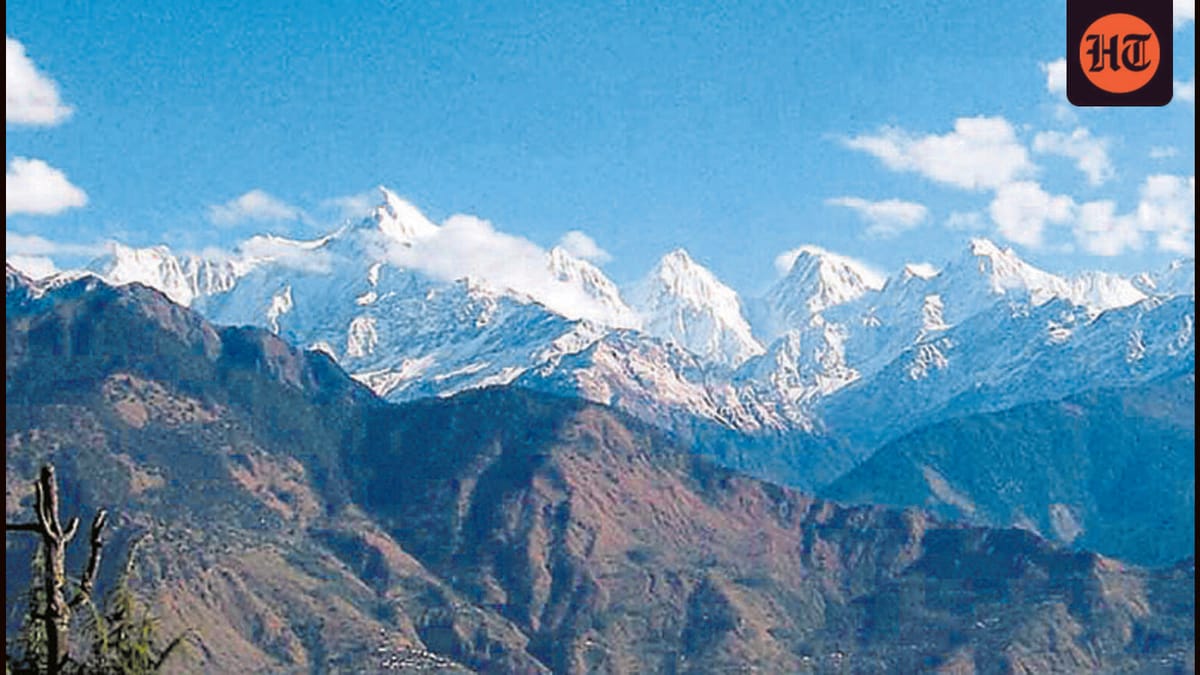
The Hindu Kush Himalaya is the only place on Earth where a mountain chain stores more ice than anywhere outside the two polar ice sheets. That is why scientists call it the Third Pole. The chain runs roughly 3,500 km from Afghanistan in the west to Myanmar in the east, and it hosts all of the world's peaks above 7,000 metres, including Everest and K2. It feeds a dozen major river basins, among them the Ganga, the Indus and the Brahmaputra, which together supply water to nearly two billion people downstream across India, Pakistan, China, Nepal, Bhutan, Bangladesh and Myanmar.
ICIMOD, the Kathmandu-based intergovernmental centre that studies the region, confirmed in its HI-WISE assessment that the Hindu Kush Himalaya contains the largest volume of ice on Earth outside the polar regions. Its glaciers feed at least ten major river systems, and the region supports about 240 million people in the mountains and a further 1.65 billion downstream.
- LOCATION | The Hindu Kush Himalaya, the Third Pole: the largest store of ice outside the Arctic and Antarctic, stretching 3,500 km across eight countries.
- PHYSICAL PROCESS | Warming air accelerates glacier melt; black carbon darkens snow and ice, absorbing heat instead of reflecting it, while retreating snowline changes the monsoon water cycle.
- HUMAN ACTIVITY | Farming, transport, hydropower and industry emit methane and black carbon; glaciers that store Asia's water are simultaneously the coolant and the victim.
- CONSEQUENCE | Floods, landslides, shifting river flows, water stress for two billion people and a cascade of risks for India's Himalayan states and northern plains.
Understand the Geography: Why the Mountains Behave the Way They Do
- Physical geography: The Himalaya rise through steep elevation bands, from tropical foothills to permanent snow and ice above roughly 5,000 metres. Glaciers store water as ice in winter and release it as meltwater in summer, which is why the rivers they feed stay flowing through the dry season.
- Cryosphere sensitivity: Snow and ice sit close to their melting point, so a small rise in temperature tips large areas into melt. This makes mountain ice far more sensitive to a fraction of a degree of warming than lowland systems, which is why the authors stress the speed of warming, not just its ultimate level.
- Human geography: The region is a corridor of human activity: hill agriculture, hydropower dams, highways, pilgrimage routes and tourism towns such as Manali and Shimla. This places people directly inside a landscape that is physically unstable at the best of times.
- The albedo feedback: White snow reflects sunlight; dark surfaces absorb it. When soot-like black carbon lands on snow, it lowers the albedo and turns the snow itself into a heater, accelerating melt in a self-reinforcing loop that is strongest exactly in mountain regions.
How Does It Work? The Climate Math Problem
The authors' argument rests on a simple difference in timing. Carbon dioxide stays in the atmosphere for centuries, so even an aggressive decarbonisation programme changes the temperature curve slowly. Short-lived climate pollutants, by contrast, warm on timescales of years to decades, which means cutting them slows the rate of warming almost immediately. For a mountain cryosphere that is already at its melting point, the rate of warming over the next twenty years matters more than the peak reached by 2100.
Climate Change Indicators
| Pollutant | Main sources | Warming timescale | Why it matters for the Himalayas |
|---|---|---|---|
| Methane | Fossil fuel leaks, livestock, rice paddies, waste | Years to a decade (about 12 years in the atmosphere) | Cuts can avoid nearly 0.3°C of warming by the 2040s; the fastest single lever |
| Black carbon | Diesel engines, biomass burning, brick kilns, open fires | Days to weeks in the air | Settles on snow and ice, darkens the surface, accelerates melting directly |
| Tropospheric ozone | Formed from methane and other precursors under sunlight | Weeks to months | A greenhouse gas and an air pollutant that hits mountain communities and crops |
| Hydrofluorocarbons (HFCs) | Refrigeration and air conditioning | Years to decades | Potent greenhouse gases; already being phased down under the Kigali Amendment |
The 0.3°C figure comes from the UNEP Global Methane Assessment, which found that cutting human-caused methane emissions by about 45% by 2030 would avoid nearly 0.3°C of global warming by the 2040s, while also preventing premature deaths, asthma-related hospital visits and crop losses from ground-level ozone. Methane is responsible for roughly 30% of the warming observed since pre-industrial times.
The column's emphasis on black carbon is a specifically Himalayan point. Most black carbon in the region comes from sources within and around the mountains, including diesel vehicles, brick kilns, biomass burning in cooking and agriculture, and seasonal forest fires. Because the aerosol lives in the atmosphere for only days or weeks, reducing it delivers a near-immediate cooling effect, and because it physically darkens the snow surface, its removal slows melting directly where the cryosphere is most exposed.
How Did We Get Here?
The Himalaya have been measured, modelled and documented for decades, but the policy response has lagged the physical change. The timeline below traces the arc from first recognition of the cryosphere's vulnerability to the current push for fast-acting pollutant cuts.
- 1987 The Montreal Protocol is signed to phase out ozone-depleting substances, later becoming the blueprint the authors want to copy for methane.
- 2009 The phrase 'Third Pole' enters common scientific use as research documents the size and sensitivity of the Hindu Kush Himalayan ice store.
- 2019 ICIMOD's first comprehensive Hindu Kush Himalaya assessment warns that up to two-thirds of the region's glaciers could be lost by 2100 on high-emission pathways.
- July 2023 Himachal Pradesh's monsoon disaster: rainfall about 50% above normal, more than 360 deaths and damages exceeding Rs 4,000 crore, which the column calls a change in Himalayan operating conditions.
- May 2023 ICIMOD publishes HI-WISE, its most accurate assessment of the region's changing cryosphere, warning that glaciers disappeared 65% faster in the 2010s than in the previous decade.
- June 2026 Zaelke and Osho publish their column on World Environment Day, arguing for a legally binding methane agreement modelled on the Montreal Protocol and seeded by India's Him-CONNECT platform.
Connect the Dots
- LOCATION | The Third Pole stores more ice than anywhere outside the poles and supplies two billion people downstream through the Ganga, Indus and Brahmaputra basins.
- PHYSICAL PROCESS | The cryosphere sits at melting point: warming air and darkening snow from black carbon accelerate glacier retreat and shift snowfall and rainfall patterns.
- HUMAN ACTIVITY | Methane from energy, agriculture and waste, plus black carbon from diesel and biomass burning, drive the fast warming that CO2 cuts alone cannot slow in time.
- CONSEQUENCE | Floods, landslides, drought and changing river flows: the July 2023 Himachal disaster is the column's proof that the human cost is already arriving.
- POLICY RESPONSE | Cut short-lived climate pollutants fast, using the Montreal Protocol as the proven template, with a coalition of mountain regions and small island states behind a methane agreement.
- OUTCOME | Slower near-term warming that buys the mountains, and the two billion people who depend on them, decades to adapt.
Why Does It Happen Here?
The Himalaya warm faster than the global average because they are a high-altitude, high-latitude-like cryosphere sitting inside the tropics. Incoming solar radiation is intense at altitude, thin air radiates heat away quickly, and snow and ice magnify every perturbation through the albedo feedback. When the air warms, the snowline climbs, exposing darker rock and soil, which absorb more heat and push the snowline higher still. That is the mechanism by which a global temperature rise of well under one degree translates into amplified, locally dramatic change in the mountains.
The authors argue that the same amplification makes the Himalaya a uniquely bad place to test a slow response. Because the system is already at its melting point, the column contends, the difference between a decade of slow CO2-driven warming and a decade of fast methane and black carbon cuts is not academic; it is the difference between rivers that swell and rivers that fail.
Regional Variation
Glacier Melt Rate
| Region | Cryosphere behaviour | Human exposure |
|---|---|---|
| Western Himalaya (Himachal, Uttarakhand) | Glaciers retreating; rainfall variability rising sharply | Flood and landslide risk on pilgrimage and tourism corridors; hydropower exposed |
| Eastern Himalaya and Karakoram | Glacier loss fastest in the east; Karakoram glaciers more stable in places | Brahmaputra basin flooding and siltation downstream |
| Trans-Himalayan plateaus (Ladakh, Spiti) | Cold deserts where snowfall and snowmelt are the dominant water source | Acute water stress; agriculture and settlements depend on a thinning snowpack |
| Indus basin headwaters | Heavy dependence on glacier and snow melt for summer flow | Irrigation for the western plains depends on melt timing and volume |
Human Impact
- Disaster risk: Rising rainfall intensity and glacial instability translate into cloudbursts, flash floods and landslides. Himachal Pradesh's July 2023 toll of more than 360 deaths and over Rs 4,000 crore in damages is the column's central example.
- Water security: Roughly two billion people depend on rivers fed by Himalayan ice and snow. As glaciers thin, summer flows first increase with extra meltwater, then decline as the ice reserve shrinks, changing the timing and reliability of water for farms and cities.
- Infrastructure: Hydropower dams, highways and mountain towns are built on terrain that becomes more unstable as permafrost thaws and slopes lose their glacial buttressing.
- Livelihoods: Hill agriculture, apple orchards, tourism and pilgrimage economies all sit at the mercy of a warming snowline and shifting monsoon behaviour.
Geographical Consequences
The physical changes are cascading. As glaciers lose mass, they first release more meltwater, then less, in a pattern hydrologists describe as 'peak water': flows rise for decades and then decline. Snow cover is projected to fall sharply, permafrost is thawing, and glacial lakes are growing behind unstable debris dams, creating the risk of glacial lake outburst floods. Each of these is a geographical mechanism with a human price, and all of them are driven by how fast, not just how much, the region warms.
Maps & Data
Geography Analysis - Table 3
| Indicator | Reading |
|---|---|
| Himalayan ice store | Largest volume of ice outside the polar regions (ICIMOD HI-WISE) |
| River basins fed by the Third Pole | About 12 major basins, including the Ganga, Indus and Brahmaputra |
| People downstream | About 240 million in the mountains; about 1.65 billion downstream in 16 countries |
| Himachal July 2023 rainfall | About 50% above normal |
| Himachal July 2023 deaths | More than 360 (state authorities later counted 400-plus) |
| Himachal July 2023 damages | Exceeding Rs 4,000 crore |
| Glacier loss trend | Glaciers disappeared 65% faster in the 2010s than in the previous decade (ICIMOD) |
| Methane cuts by 2030 | About 45% reduction could avoid nearly 0.3°C of warming by the 2040s (UNEP Global Methane Assessment) |
What Is Clear? What Is Changing?
- What is clear: The Third Pole holds the world's largest ice store outside the poles; it is warming and melting faster than the global average; CO2 reductions are essential but too slow to protect the near-term mountain system; and short-lived climate pollutants warm on timescales of years to decades and are cuttable within a decade.
- What is clear: The Montreal Protocol phased out nearly 100 ozone-depleting chemicals, is projected to avoid more than 2.5°C of warming by 2100, and succeeded as a coalition of willing countries before it became universal.
- What is changing: Himalayan snowfall and rainfall patterns are shifting, the snowline is climbing, glacial lakes are growing, and disasters like Himachal's July 2023 floods are arriving earlier than projections for the region anticipated.
- What is uncertain: Whether a legally binding methane agreement can actually be negotiated, how it would be financed and enforced, and whether the near-term climate benefits of methane cuts are realised at the full projected scale.
What Could Happen Next?
The column's proposal is concrete: a coalition of mountain regions and small island states should pursue a legally binding methane agreement modelled on the architecture of the Montreal Protocol, including its funding mechanism for developing countries and its coalition-of-the-willing start. India, through its Him-CONNECT platform, is positioned as a bridge between the Himalayas and global climate diplomacy. Whether this becomes a treaty, a sectoral pledge or a series of national programmes will be decided by diplomacy, not by the science, and the authors argue the science does not allow a long wait.
The Montreal Protocol is the load-bearing precedent in the column, and its lessons are specific. Signed in 1987, it did not wait for universal agreement before acting: it began with a group of willing countries, set binding phase-out schedules, created a multilateral fund to help developing countries comply, and then expanded its membership until it became the only treaty with universal ratification. The authors argue a methane deal can follow the same path, starting smaller, moving faster, and leaving room for countries to join as benefits become visible.
Why Does It Matter for India?
No country is more exposed to the Third Pole's fate than India. The Ganga and the Brahmaputra, the rivers that anchor northern and eastern India's water supply, both begin in Himalayan ice. When the glaciers thin, the summer flows that irrigate the north Indian plains and fill the reservoirs of Himalayan hydropower become less predictable, at the same time as the plains themselves face more intense rainfall. The July 2023 Himachal disaster was not a Himalayan event in isolation: it was a preview of how mountain change transmits into Indian risk, from insurance claims in Shimla to water stress in the Gangetic plains.
The authors see India as both a victim and a leader. As a cryosphere-facing nation with growing methane emissions from livestock, rice, waste and fossil fuels, India is exposed to the consequences the column describes. But as host of the Him-CONNECT platform, the authors argue, India can also seed the coalition that turns a regional problem into a binding global deal, the same way a small group of countries once seeded the Montreal Protocol.
CONCEPT BEHIND THE NEWS
Bottom Line
The Himalayas are the Third Pole: the largest store of ice outside the polar regions, and the water tower for two billion people. They are warming faster than the global average, and CO2 cuts alone cannot slow that warming fast enough to protect the mountain system in the next two decades. The fastest lever, Zaelke and Osho argue, is cutting short-lived climate pollutants, chiefly methane and black carbon, using the Montreal Protocol as the proven template. For India, whose rivers begin in Himalayan ice, the choice is not abstract: it is the difference between managing Himalayan water and being managed by it.
Key Geographical Terms
- Third Pole: the Hindu Kush Himalaya, which stores the largest volume of ice on Earth outside the polar regions.
- Cryosphere: the parts of the planet covered by snow, ice, glaciers and permafrost.
- Albedo: the reflectivity of a surface; bright snow reflects sunlight, while dark deposits such as black carbon absorb heat and speed melting.
- Short-lived climate pollutants: methane, black carbon, tropospheric ozone and HFCs, which warm the atmosphere on timescales of days to decades.
- Black carbon: soot from diesel, biomass burning and brick kilns that settles on snow and ice, darkening it and accelerating melt.
- Glacial lake outburst flood (GLOF): a flash flood released when a glacial lake's natural dam of ice or debris fails.
- Peak water: the point at which meltwater flows from a shrinking glacier first rise, then begin to decline as the ice reserve diminishes.
Read More
- Hindustan Times (Original article source)
- Explore More (Related articles in Geography)
Sources & Further Reading
- Primary | Durwood Zaelke and Zerin Osho, "Saving the saviour: the Himalayas need us", Hindustan Times, June 5, 2026
- Corroboration | UNEP and Climate & Clean Air Coalition, "Global Methane Assessment: Benefits and Costs of Mitigating Methane Emissions", May 2021 (on the ~0.3°C avoided warming by the 2040s from a 45% methane cut by 2030)
- Corroboration | UNEP Ozone Secretariat, "The Montreal Protocol on Substances that Deplete the Ozone Layer" (on the phase-out of nearly 100 ozone-depleting substances)
- Corroboration | ICIMOD, "Water, Ice, Society, and Ecosystems in the Hindu Kush Himalaya (HI-WISE) Outlook", 2023 (on the Third Pole's largest ice store outside the poles and glacier loss trends)
- Corroboration | The Hindu, reporting on Himachal Pradesh's July 2023 monsoon disaster (state authorities later counted 400-plus deaths)
- Corroboration | Hindustan Times, "Himachal rains: losses touch Rs 5,691.79 crore by end of July", August 2, 2023 (on damages exceeding Rs 4,000 crore)
- Further Reading | Yale Environment 360, on the Montreal Protocol's projected avoidance of more than 2.5°C of warming by 2100 (citing the 2021 Nature study on ozone and climate)
- Further Reading | ICIMOD, "Hindu Kush Himalaya Assessment Report", 2019 (on projected glacier loss of up to two-thirds by 2100 on high-emission pathways)