Mecca Accord: Why Arab States Still Struggle to Build Their Own Security System
Saudi Arabia, Turkey and Pakistan have created a new security arrangement. But why was such an arrangement necessary in the first place, and what does it reveal about the Middle East's dependence on outside powers?
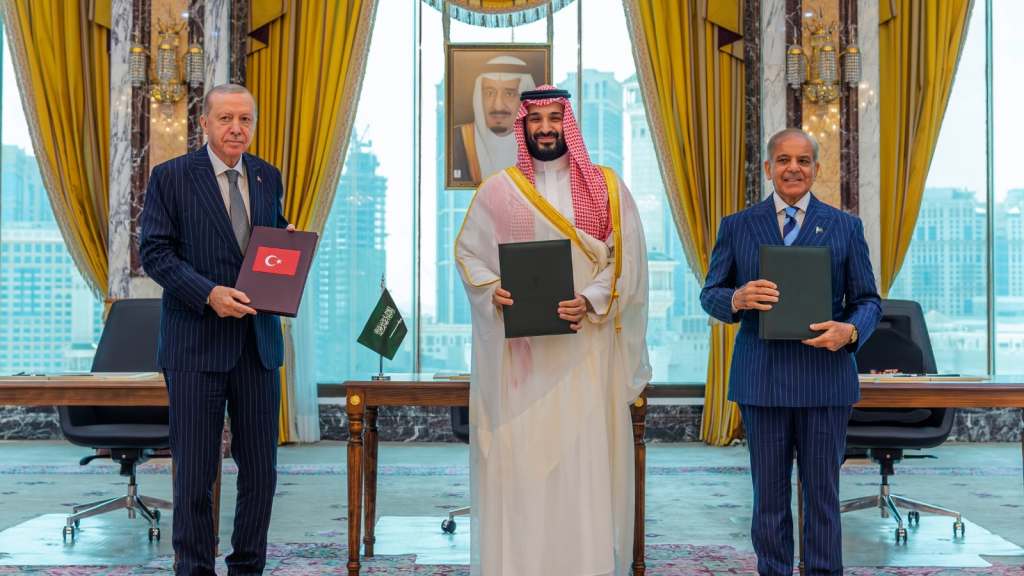
Saudi Arabia, Turkey and Pakistan have created a new security arrangement. But why was such an arrangement necessary in the first place, and what does it reveal about the Middle East's dependence on outside powers? On the surface, the Mecca Joint Defence Agreement signed on August 7, 2026, looks like a milestone in Islamic security cooperation. Look closer, and it raises a harder question: can Middle Eastern states build a credible security architecture of their own, or are they still, seventy years on, waiting for someone else to guarantee their safety?
What is the Mecca Joint Defence Agreement of 2026?
On August 7, 2026, Saudi Arabia, Turkey and Pakistan signed the Mecca Joint Defence Agreement, a framework for joint exercises, intelligence sharing and security coordination whose binding commitments are not public. It reflects doubts about traditional external security guarantees, but the article argues it is less a unified Muslim security bloc than a hedge.
The Story in 60 Seconds
What Actually Happened?
On August 7, 2026, the leaders of Saudi Arabia, Turkey and Pakistan signed a joint defence agreement in Mecca, Saudi Arabia. The signing followed meetings among the three countries over the preceding weeks.
The agreement is a framework for defence and security cooperation. It commits the three countries to explore closer military ties, joint exercises, intelligence sharing and coordination on security matters. The precise scope of binding military commitments is not publicly known.
Observers read the accord in different ways: some see it as a step toward Islamic security self-reliance, others as a hedge against American unreliability, and still others as largely symbolic. These are interpretations, not established outcomes.
What remains unclear is how much the agreement will translate into operational cooperation. No command structures, force levels, intelligence-sharing mechanisms or financial commitments have been published.
Meet the Players
Saudi Arabia — Crown Prince Mohammed bin Salman
Prime Minister
Saudi Arabia's security concerns are dominated by the threat it perceives from Iran and its regional proxies, and by its dependence on American protection for its own defence. Riyadh has long sought to diversify its security partnerships so it is never hostage to the reliability of a single patron. The kingdom also wants to project itself as the leading power of the Arab and Islamic world, which gives any 'Islamic' initiative a natural appeal.
Turkey — Recep Tayyip Erdoğan
President
Turkey brings substantial military capability, including the region's largest NATO army after the United States, a growing drone industry, and a track record of military intervention in the Middle East and beyond. Ankara has its own regional ambitions and an uneasy relationship with many Arab states. Its inclusion in an 'Islamic' security pact lets it play a central role in a project that rivals other regional groupings.
Pakistan — Shehbaz Sharif
Prime Minister
Pakistan brings a large, professional army, nuclear status and long-standing, if guarded, security ties with Saudi Arabia. Its relationship with Riyadh has historically been limited: when Saudi Arabia intervened in Yemen in 2015, Pakistan's parliament voted for neutrality. Pakistan also carries a deep geopolitical rivalry with India, which shapes every foreign policy calculation it makes.
Why aren't the Arab states doing this alone?
This is the heart of the matter. If the goal were genuine Arab or Islamic collective security, the Gulf states and the wider Arab world would be natural partners. Instead, the initiative is led by three states that are not, in fact, a natural bloc: an Arab monarchy, a non-Arab Muslim republic with NATO membership, and a nuclear-armed South Asian state. C. Raja Mohan's argument is that this is precisely the point: the arrangement is not a sign of strength but a symptom of enduring Arab weakness.
How Did We Get Here?
- 1950s-60s External powers become central to Middle Eastern security after the collapse of European colonial rule.
- 1960s-80s Regional states attempt different forms of cooperation, from the United Arab Republic to the Baghdad Pact, with limited success.
- 1980s The Iran-Iraq War reshapes Gulf security calculations and deepens dependence on outside protection.
- 1981 Gulf states create the Gulf Cooperation Council (GCC) as a regional security framework.
- 1990-91 Iraq's invasion of Kuwait demonstrates the limits of regional collective security: it takes an American-led coalition to reverse it.
- 2003 The US invasion of Iraq dramatically changes the regional balance and unsettles long-standing security assumptions.
- 2010s Arab uprisings, civil wars and the Iran-Saudi rivalry reshape regional politics.
- 2020s Growing questions about the reliability of US commitments push regional states to seek strategic autonomy.
- 2026 Saudi Arabia, Turkey and Pakistan sign the Mecca Joint Defence Agreement.
What Does 'Arab Weakness' Actually Mean?
The phrase 'Arab weakness' is easy to repeat and hard to define. Breaking it down helps:
Arab Alliance Countries
| Dimension | What it means |
|---|---|
| Political fragmentation | Different Arab states have different and often competing interests. |
| Military fragmentation | Having armies is not the same as having an integrated regional defence system. |
| Strategic dependence | Regional states have historically depended heavily on external powers for security. |
| Rivalries | Saudi Arabia, Iran, Turkey, Israel and other regional actors hold competing interests. |
| Institutional weakness | Regional organisations do not automatically produce collective military capability. |
The key distinction: weakness does not mean that Arab states are militarily weak. It can mean that their combined capabilities are difficult to convert into coordinated strategic power. One country can buy advanced aircraft; several countries cannot easily agree on who commands them.
Connect the Dots
- US security guarantees underwrite the region for decades
- Arab states' dependence on external protection grows
- Growing uncertainty about US reliability
- Search for alternative partnerships begins
- Saudi Arabia + Turkey + Pakistan
- Mecca Joint Defence Agreement signed
- Question of regional strategic autonomy
But Is the Mecca Accord Really About 'Arab Weakness'?
Raja Mohan's reading is that the accord is a hedge against American unreliability, not Islamic security self-reliance. That is one interpretation. Competing interpretations are worth weighing.
Security Framework Comparison
| Interpretation | Core claim |
|---|---|
| 1. A sign of weakness | The agreement demonstrates that Arab states still cannot construct an effective collective-security mechanism themselves. |
| 2. Strategic adaptation | It shows Saudi Arabia diversifying its security partnerships rather than depending on one external power. |
| 3. Hedging | The agreement is a hedge against uncertainty rather than an attempt to create a fully independent security architecture. |
| 4. Symbolism versus capability | Signing an agreement is politically significant, but its strategic importance ultimately depends on command structures, interoperability, intelligence sharing, logistics, military planning, financial commitments and the willingness to fight together. |
What Happens Next?
- Scenario A, the agreement deepens — More military exercises, intelligence cooperation and defence coordination follow.
- Scenario B, it remains largely symbolic — The agreement generates diplomatic headlines but limited operational integration.
- Scenario C, more countries join — Other regional states could explore participation or parallel arrangements.
- Scenario D, external powers respond — The US, China, Iran, Israel and Russia could adjust their regional strategies.
What would we need to see before concluding that this is becoming a genuine security architecture? Published command structures, joint exercises of real scale, visible intelligence sharing, and a test of the members' willingness to act together in a crisis.
Why India Should Care
International Relations Analysis - Table 3
| Why it matters | The detail |
|---|---|
| Energy security | The Gulf is a critical source of India's oil and gas imports, and any shift in Gulf security arrangements touches supply routes. |
| Indian diaspora | Millions of Indians live and work across the Gulf, whose safety depends on regional stability. |
| Trade | The Middle East is a major trading partner and a corridor for India's economic links westward. |
| Defence relationships | India has growing defence ties with Gulf states, including Saudi Arabia and the UAE. |
| Pakistan | Any enhancement of Pakistan's strategic role in the Gulf affects the balance India watches in its own neighbourhood. |
| Indian Ocean | Gulf instability directly affects the security of the Indian Ocean and India's western maritime approaches. |
What should New Delhi watch? India should monitor the accord's operational content, because that determines whether a new military actor or grouping is emerging in a region vital to India. It should watch how far Pakistan's involvement extends, because that could change the regional balance India deals with daily. And it should watch how external powers respond, because the strategic architecture of the Middle East is being renegotiated in real time.
Who Could Gain? Who Could Feel Pressure?
International Relations Analysis - Table 4
| Actor | Possible gain |
|---|---|
| Saudi Arabia | Greater strategic options and a hedge against dependence on a single patron |
| Turkey | Greater regional influence and a central role in a new Islamic security project |
| Pakistan | Deeper strategic relevance and a stronger position in the Gulf |
| United States | Potential burden-sharing from partners who assume more of their own security |
| Other Gulf states | Alternative security partnerships to explore |
International Relations Analysis - Table 5
| Actor | Possible pressure |
|---|---|
| Iran | A grouping of rivals could tighten containment around it |
| Israel | A new Islamic security project could complicate its calculations |
| United States | It could face partners hedging against its reliability |
| Other Gulf states | They could feel left out of an arrangement among major powers |
| Arab states outside the arrangement | Their security concerns could be overlooked in a three-power initiative |
These are potential effects, not established outcomes. They are analytical scenarios for thinking about the accord, not predictions.
How Should We Judge the Mecca Accord?
- 1. Capability: do the members actually possess complementary military capabilities?
- 2. Commitment: would they fight for one another in a real crisis?
- 3. Integration: are their militaries operationally integrated?
- 4. Geography: can they realistically support each other across different theatres?
- 5. Strategic durability: will the agreement survive changes in leadership and regional politics?
An initial assessment
| Political significance | High | It changes the political conversation in the region today. |
|---|---|---|
| Strategic significance | Potentially high | It becomes a strategic fact only with real investment behind it. |
| Operational significance | Yet to be demonstrated | Nothing on the ground proves the accord works yet. |
The accord changes the political conversation in the region today; it becomes a strategic fact only if the members invest in capability, commitment and integration.
CONCEPT BEHIND THE NEWS
Bottom Line
Saudi Arabia, Turkey and Pakistan signed a joint defence agreement that looks like a milestone but may be better understood as a symptom of the Middle East's struggle to build its own security architecture. The pattern of history, from the Baghdad Pact to the GCC, is that national interest repeatedly defeats supranational identity. The accord is a hedge against uncertainty, not proof of self-reliance. Its significance will be settled by operational reality, not by the signing ceremony.
Key Terms
- GCC: the Gulf Cooperation Council, a regional bloc of six Gulf states founded in 1981.
- Hedge: an arrangement made to protect against risk, here the risk of unreliable external protection.
- Interoperability: the ability of different militaries to operate together effectively.
- Strategic autonomy: the capacity of a state or group to secure its own interests without dependence on outside powers.
- Collective security: a system in which members agree to defend one another against common threats.
Read More
- The Indian Express (Original article source)
- Explore More (Related articles in International Relations)
Sources & Further Reading
- Primary: official statements from the governments of Saudi Arabia, Turkey and Pakistan on the joint defence agreement.
- Primary: the text of the agreement as released by the signatories.
- Analysis: C. Raja Mohan, 'C Raja Mohan writes: The Mecca Accord exposes Arab weakness', The Indian Express, first published August 11, 2026, updated August 12, 2026.
- Context: histories of the Baghdad Pact, CENTO, the GCC and earlier Arab collective-security efforts.