Bhagwat's Gen Z Endorsement and the Lesson for the Modi Government
Shekhar Gupta reads RSS chief Mohan Bhagwat's endorsement of Gen Z protesters as a rare public caution to the Modi government, and draws an Indira Gandhi-era lesson about leaders who have no one to counsel them.
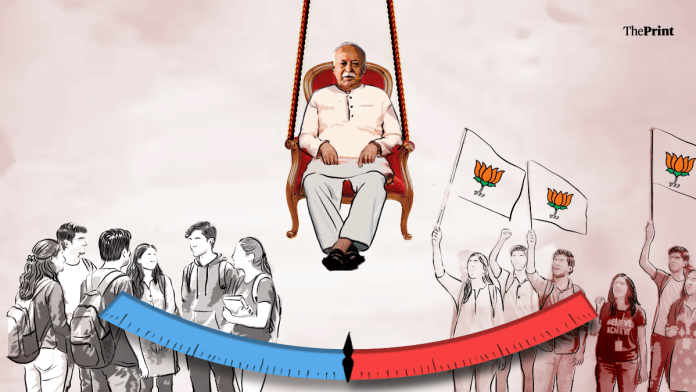
Why does the RSS chief publicly endorsing Gen Z protest matter for India's institutional system? Days after the government ended its 36-day confrontation with student protesters over the NEET-UG paper leak, Mohan Bhagwat told IIMUN students in Mumbai that protest is a right in a democracy and not anti-national. The obvious reading is that the Sangh is course-correcting a government it fears is damaging itself. The harder question is what this tells us about the institutional checks on a dominant executive.
Why did RSS chief Mohan Bhagwat's endorsement of Gen Z protests matter?
On 6 August 2026, Mohan Bhagwat told IIMUN students in Mumbai that protest is a democratic right and not anti-national, days after a 36-day agitation over the NEET-UG paper leak ended with the Education Minister's resignation. Shekhar Gupta reads it as a rare public caution from the Sangh to a dominant government with few internal checks.
The Story in 60 Seconds
What Actually Happened?
On 6 August, at the IIMUN 15th anniversary event in Mumbai, Bhagwat addressed roughly 2,000 Gen Z and Gen Alpha students. "I have faith in Gen Z," he said. "Protest is a right in democracy, it isn't anti-national." He called the protesters' grievances genuine, said 6% of GDP should be spent on education, and argued that young people "respond better to dialogue, not dictation."
The agitation began, in effect, with the judiciary, not the streets. On 15 May, during an unrelated Supreme Court hearing, CJI Surya Kant referred to unemployed young people as "cockroaches". The remark was read as demeaning the youth, and although the CJI later clarified he meant holders of fake degrees, a student's satirical post the next day proposed a "Cockroach Janta Party" and the label took off. Weeks later, after the NTA cancelled NEET-UG 2026 over the paper leak on 12 May, reports of aspirants dying by suicide mounted. The CJP began its Jantar Mantar sit-in on 20 June demanding Education Minister Dharmendra Pradhan's resignation; climate activist Sonam Wangchuk joined with an indefinite hunger strike on 28 June. On 20 July, a "Sansad Chalo" march drew a heavy police response. When the CJI was asked on 22 July to urgently hear a plea over the crackdown, he declined, saying the court had no time to watch videos. On 25 July, Pradhan resigned and the government accepted the movement's demands, including compensation for the families of students who died by suicide and withdrawal of FIRs against protesters. On 27 July, BJP MP Kangana Ranaut called Gen Z protesters "generation gutter". On 30 July, RSS joint general secretary Atul Limaye told ABVP workers in Chhatrapati Sambhajinagar that the agitation had carried anti-national slogans and tested the Left's "alternative politics".
Kangana then publicly reversed herself, telling reporters on 7 August that "Gen Z is our biggest strength, and we are proud of the generation". Gupta argues the correction clearly came from the very top.
- 15 May: a Supreme Court hearing touches on the revised school textbook, and the judiciary becomes the flashpoint.
- Gen Z student protests spread across campuses, framed around merit, fairness and the rewritten books.
- The RSS chief, at IIMUN's 15th anniversary in Mumbai, publicly endorses the Gen Z agitation and the right to protest.
- 7 August: Kangana Ranaut publicly reverses course, calling Gen Z the biggest strength of the country.
- Reading: the episode is cast as the RSS repositioning itself ahead of its centenary.
Gupta reads the episode as the RSS repositioning itself ahead of its centenary, leaving both its hardline conservative base and the hard liberal community confused. The fundamental ideology of the RSS, he insists, is not about to change: what is on display is political pragmatism in the 13th year of power.
Whether Bhagwat's leadership line, "Leadership is to create leaders, it is not to lead by myself only", was aimed at anyone in particular is a question nobody in the BJP would dare raise or answer.
Constitutional / Legal / Institutional Background
The right to protest is a constitutional value, not a concession. Article 19(1)(a) guarantees freedom of speech and expression and Article 19(1)(b) the right to assemble peaceably and without arms. Both may be reasonably restricted only on the grounds listed in Article 19(2) and 19(3).
Calling a peaceful protest "anti-national" is therefore a political claim, not a legal one. The Emergency, imposed under Article 352, is the constitutional warning of what happens when protest is treated as a national-security threat. The irony, as Gupta notes, is that BJP and RSS leaders were jailed during it.
Under ordinary law, public agitations are policed through permits, prohibitory orders and proportionate restrictions on assembly. The question is never whether protest is legal in the abstract, but whether the state applies reasonable restrictions to peaceful assembly. In the CJP case, the Supreme Court also heard pleas on alleged police excesses during the protest.
How Did We Get Here?
- 3 May 2026 NEET-UG 2026 is held across the country for more than 22 lakh candidates, before the paper-leak allegations that would force its cancellation surface.
- 12 May 2026 The NTA cancels NEET-UG 2026 after finding that a leaked PDF closely matched the paper. The government orders a CBI probe and announces a nationwide re-test for 21 June.
- 15 May 2026 During an unrelated Supreme Court hearing, CJI Surya Kant refers to unemployed young people as "cockroaches". The remark is widely read as demeaning the youth.
- 16 May 2026 A student posts a satirical proposal for a "Cockroach Janta Party" for angry, jobless aspirants. The CJI clarifies his remark was aimed only at holders of fake degrees, but the label has already spread.
- 19 Jun 2026 CJP founder Abhijeet Dipke writes to the PM citing 11 NEET aspirants who died by suicide and demands Rs 1 crore compensation for each family, before the sit-in begins.
- 20 Jun 2026 The CJP begins its sit-in at Jantar Mantar, demanding the resignation of Education Minister Dharmendra Pradhan over the leak and exam irregularities.
- 21 Jun 2026 The NEET-UG re-test is held under heightened security. For millions of students, months of preparation have already been disrupted.
- 28 Jun 2026 Climate activist Sonam Wangchuk joins the CJP and begins an indefinite hunger strike at Jantar Mantar, linking exam accountability with Ladakh concerns.
- 18 Jul 2026 Wangchuk is hospitalised on the 21st day of his fast. CJP founder Dipke begins his own indefinite hunger strike, and left student groups join the protest.
- 20 Jul 2026 A "Sansad Chalo" march turns confrontational; Delhi Police act against protesters with tear gas near Shastri Bhawan and metro curbs. Over 100 protesters are taken to RML Hospital.
- 22 Jul 2026 CJI Surya Kant refuses to urgently hear a plea over the police crackdown, telling the lawyer: "We are not interested in videos; we don't have time to watch."
- 25 Jul 2026 Education Minister Dharmendra Pradhan resigns. The government accepts the CJP's demands, including compensation for families of students who died by suicide, and the 36-day protest is called off.
- 27 Jul 2026 BJP MP Kangana Ranaut calls Gen Z protesters "generation gutter" in Instagram posts.
- 30 Jul 2026 RSS joint general secretary Atul Limaye tells ABVP workers in Chhatrapati Sambhajinagar that the agitation carried anti-national slogans.
- 5 Aug 2026 Parliamentary Affairs Minister Kiren Rijiju shares an old Indira Gandhi interview defending the Emergency, urging the "young generation" to see it.
- 6 Aug 2026 Bhagwat tells IIMUN students in Mumbai he has faith in Gen Z: protest is a right in a democracy, not anti-national.
- 7 Aug 2026 Kangana reverses, calling Gen Z "our biggest strength". The correction, Gupta argues, came from the very top.
Who Are the Institutions & Actors Involved?
Youth Demographics
| Institution | Who they are | What they did |
|---|---|---|
| RSS (Sangh) | The ideological parent organisation; Mohan Bhagwat is its sarsanghchalak | Publicly endorsed Gen Z protest as legitimate; repositioned the Sangh ahead of its centenary |
| The Modi government | The BJP-led executive in its 13th year of power | Initially resisted demands; after 36 days, Education Minister Pradhan resigned and the government accepted the CJP's demands |
| Parliament & ministers | Including Parliamentary Affairs Minister Kiren Rijiju | Senior ministers had said they would not resign under pressure; Rijiju then shared the Indira Gandhi Emergency interview to defend the government's response, not to climb down |
| Gen Z protesters / CJP | Students and the Cockroach Janta Party at Jantar Mantar over the NEET-UG paper leak | Ran a 36-day agitation that ended with the Education Minister's resignation and acceptance of their demands |
| ABVP / hardline fringe | The RSS student wing and the "trad" grouping to its right | Pushed the anti-national framing that Bhagwat then publicly demolished |
Connect the Dots
- NEET-UG 2026 paper leak triggers a student agitation at Jantar Mantar
- Government initially refuses to give in; ministers say they will not resign under pressure
- Hardline voices frame the protesters as anti-national
- After 36 days, Pradhan resigns and the government accepts the demands
- Bhagwat intervenes publicly: protest is a right, not anti-national
- Kangana and the government signal a course correction
- Bhagwat underlines the RSS as the guru that counsels the shishya government
Core Constitutional / Governance Issues
The first issue is the boundary of legitimate protest. Framing peaceful student agitation as anti-national conflates dissent with sedition, the exact slide the Constitution was designed to prevent.
The second is the Emergency lesson. Indira Gandhi's blunder, as Gupta frames it, was not only legal but institutional: no senior counsellor, mentor, family figure or guru was there to caution her. The RSS intervention is a live demonstration of the informal checks that operate within a dominant political ecosystem.
The Debate
Electoral Participation Trends
| Perspective | Position |
|---|---|
| In favour (Bhagwat / RSS) | Protest is part of consensus-building; youth respond to dialogue, not dictation; Gen Z is a strength, not a threat |
| Against (hardline "trad" base) | The agitation tested Left "alternative politics"; the students' slogans were anti-national |
| Constitutional perspective | Peaceful protest is a guaranteed right under Article 19; only reasonable restrictions are permissible |
| Institutional perspective | Informal checks, a "guru RSS", can act where formal institutions are politically aligned with the executive |
What Changes in Practice?
The immediate change is political: the anti-national framing of the youth movement has been publicly delegitimised from the very top. The deeper change is signalling: the RSS has demonstrated that it can, and will, counsel the government publicly when it sees political damage. What it does not change is the RSS's fundamental ideology, which Gupta insists remains intact.
What Is Clear?
The facts are clear and widely reported: Bhagwat's words at IIMUN, Kangana's reversal, the CJP agitation and Pradhan's resignation, and Rijiju's decision to share the Indira Gandhi interview.
What Remains Contested?
That this was a deliberate, top-down course correction is Gupta's reading of the sequence, corroborated by the timing and the immediate reversal of the earlier framing.
Whether this is a durable shift in the RSS-BJP relationship or a temporary "good cop" intervention for a beleaguered government remains open.
What Could Happen Next?
- Scenario A, the course correction deepens — The government adopts a softer posture toward student demands and opens dialogue on exam reform.
- Scenario B, it is tactical only — The intervention cools the moment; the hardline framing returns once the agitation fades.
- Scenario C, the RSS asserts more — The Sangh increasingly positions itself as the moral referee of the government's politics.
- Scenario D, blowback within the Sangh — The "trad" base's anger at Bhagwat grows, reshaping Sangh politics and succession.
Why Does It Matter?
For students of polity, the episode is a live case study in how informal power constrains a dominant executive. For citizens, it legitimises peaceful protest as a constitutional value. For the government, it is a reminder that the institutions of the state are not the only check on power: ideology, family and public reputation are too.
CONCEPT BEHIND THE NEWS
Bottom Line
Bhagwat's endorsement of Gen Z is less a change of RSS ideology than a public reassertion of its role as the guru to the Modi government. It legitimises peaceful protest, forces a course correction, and reminds us that the checks on executive power in India are not only constitutional but also informal, ideological and personal.
Key Constitutional / Legal Terms
- Article 19.
- (a) | Freedom of speech and expression, subject to reasonable restrictions.
- (b) | The right to assemble peaceably and without arms.
- Reasonable restrictions | Limits permitted under Article 19 on grounds including sovereignty, security and public order
- Emergency (Article 352) | A national emergency under which fundamental rights can be suspended
- Section 144 CrPC | A provision allowing authorities to prohibit assembly in an area
Read More
- ThePrint (Original article source)
- Explore More (Related articles in Polity)
Sources & Further Reading
- Primary | Shekhar Gupta, "Guru RSS is cautioning shishya Modi govt. Bhagwat's endorsement of Gen Z has an Indira lesson", ThePrint, 8 August 2026
- Corroboration | "Gen Z grievances genuine, protesters not anti-national: Mohan Bhagwat", Business Standard, 7 August 2026
- Corroboration | "'Protesting doesn't make youth anti-national': Bhagwat urges dialogue at Gen Z gathering", The New Indian Express, 6 August 2026
- Corroboration | "Govt bows down to CJP's 3 demands, Jantar Mantar protests called off", Deccan Chronicle, 25 July 2026
- Corroboration | "CJP Protest, Student Protest, Jantar Mantar, NEET Paper Leaks, Dharmendra Pradhan Resignation", NDTV, July 2026
- Corroboration | "Rijiju draws parallel between Indira's Emergency defence and protest crackdown", ThePrint, 6 August 2026
- Context | "DNA of all Bharatiyas is same, irrespective of religion: Mohan Bhagwat", reports 2021-2025
- Context | Five Muslim intellectuals (S Y Quraishi, Najeeb Jung, Shahid Siddiqui, Zameer Uddin Shah, Saeed Shervani) met Bhagwat on 22 August 2022, widely reported