NASA Wants ISRO on Its Moon Base. The Real Question Is Governance, Not Rockets
At the ninth India-US Civil Space Joint Working Group, hosted by India in Bengaluru on 5-6 August 2026, NASA invited ISRO to join its Moon Base programme under the Artemis Accords. Ajey Lele of MP-IDSA argues that behind the diplomatic glow sits a harder question: whether a voluntary, non-binding framework built outside the UN negotiating process could compromise India's strategic autonomy in lunar exploration. The risks run through interoperability standards, a data-sharing gap, and asymmetries in lunar resources and safety zones. For India, he argues, the issue is not whether to cooperate, but whether cooperation embeds norms that were never universally negotiated.
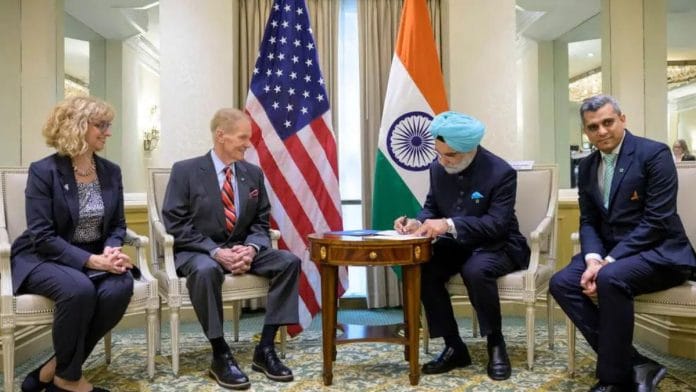
On 5-6 August 2026, at ISRO headquarters in Bengaluru, NASA did something it had never done before with India: it formally invited ISRO to join its Moon Base programme. On the surface, this is a triumph, the reward of two decades of deepening India-US space cooperation and the ultimate recognition for an agency that soft-landed near the lunar south pole in 2023. The obvious reading is that India has arrived as a first-rank lunar power. The harder question, raised by Ajey Lele of the Manohar Parrikar Institute for Defence Studies and Analyses (MP-IDSA), is whether the invitation asks India to enter a system of rules, not just a project. The real question is not whether India can reach the Moon. It is who writes the rules when it gets there.
Is ISRO joining NASA’s Artemis Moon Base programme?
NASA formally invited ISRO to join its Moon Base programme at Bengaluru on 5-6 August 2026, a first. The engineering case is clear after Chandrayaan-3’s 2023 south-pole landing; the real question is governance. India must decide the terms of participation, IP, cost share and command, not whether to build rockets.
The Story in 60 Seconds
What Happened?
The ninth meeting of the India-US Civil Space Joint Working Group (CSJWG) was hosted by India on 5-6 August 2026 at ISRO headquarters in Bengaluru. It advanced civil and commercial space cooperation under the US-India Transforming the Relationship Utilizing Strategic Technology (TRUST) Initiative, in line with the February 2025 Joint Leaders' Statement by Prime Minister Modi and President Trump. During the meeting, NASA invited ISRO to join its Moon Base programme, building on the two countries' partnership under the Artemis Accords. The two sides also agreed to advance discussions for cooperation on open scientific data sharing under the Accords.
The invitation stands on a concrete foundation. India signed the Artemis Accords in June 2023 as the 27th signatory, and the framework has since grown to around 70 signatories, with Mauritius becoming the 70th on 17 July 2026. A recent flagship of the partnership is the NISAR satellite, launched on 30 July 2025, an Earth-observation mission using dual-frequency radar (L-band and S-band) from a single platform to support disaster management, agriculture and climate monitoring. Lele notes that joining the Moon Base would be a step beyond the Accords themselves: India would need to sign a separate, project-specific bilateral implementing agreement with the United States.
Lele, deputy director general of MP-IDSA, reads India's participation in this system as an important 'peak' in the Indo-US strategic partnership, viewed through the prism of geopolitics. His argument is that this is precisely the moment for India to look beyond geopolitics and assess such initiatives from the broader perspectives of space sustainability and security, rather than simply celebrating the invitation.
What joining the Moon Base would concretely mean for ISRO, in engineering, funding, data rights and operational control, has not been publicly specified. The CSJWG statement records the invitation, but the operative terms would be worked out later in a bilateral implementing agreement. Until those terms are public, the practical content of the offer remains unknown.
What Is the Moon Base Programme?
- What is it?: The Moon Base is NASA's plan, developed with partner states, to build humanity's first lunar outpost, a place where astronauts will live, work and explore near the Moon's south pole. NASA describes it as a series of crewed and uncrewed missions building the infrastructure for an enduring human presence on the lunar surface.
- How is it governed?: Participation is organised under the Artemis Accords, the 2020 set of principles for peaceful, sustainable and transparent civil space exploration. Signing the Accords is the entry ticket; mission participation is then arranged bilaterally.
- Why the south pole?: The south polar region contains permanently shadowed craters that may hold water-ice, the resource most likely to sustain a lunar base, provide drinking water and oxygen, and be broken down into hydrogen and oxygen for rocket fuel.
- What could ISRO contribute?: ISRO brings demonstrated soft-landing and rover capability from Chandrayaan-3, polar engineering experience and a record of low-cost mission design. The specific contribution would be a matter of negotiation.
The central point for a reader new to this story is that the Moon Base is as much an institutional project as an engineering one. Its rules of the road, the Artemis Accords, were launched by the United States and seven other nations in October 2020 as a non-binding framework, then expanded outward through bilateral agreements. NASA now invites every signatory to take part in the Moon Base, which it says puts the Accords' principles into practice. That makes the Accords the constitutional document of the lunar economy now being built.
How Does the Artemis System Work?
- Sign the Accords: a voluntary national commitment to principles
- Negotiate participation: mission arrangements agreed bilaterally
- For the Moon Base: a project-specific implementing agreement
- Operate under agreed norms: interoperability, data sharing, safety zones
- Norms evolve outside the UN: in parallel to the COPUOS process
Two features of this system matter for India. First, the Accords are voluntary and non-binding; signing them commits a state to principles, not to specific missions. Second, every concrete step, including the Moon Base invitation, is operationalised through bilateral agreements between the United States and a partner. India has already taken the first step. The implementing agreement would be the second, and it is there that the fine print on standards, data and resources would be written.
How Did We Get Here?
India's path to this invitation runs through two decades of lunar science and a parallel diplomatic track. Chandrayaan-1 detected water molecules on the Moon in 2008. Chandrayaan-3 achieved a historic soft landing near the lunar south pole in August 2023. On the diplomatic side, the CSJWG, established in 2005, became the workhorse of India-US civil space cooperation, and the Artemis Accords, which India joined in 2023, became the framework of the lunar economy. The Moon Base invitation is where those two tracks finally meet.
- 1967 The Outer Space Treaty opens for signature, establishing that celestial bodies cannot be nationally appropriated, the foundation of UN space law.
- 1979 The Moon Agreement declares lunar resources the common heritage of mankind, though few states ratify it, leaving resource rules thin in practice.
- 2005 The India-US Civil Space Joint Working Group is established as a mechanism for bilateral civil space cooperation.
- 2008 Chandrayaan-1 detects water molecules on the lunar surface, reshaping the science case for polar exploration.
- 2020 The United States and seven founding nations launch the Artemis Accords, a non-binding set of principles for responsible lunar exploration.
- June 2023 India signs the Artemis Accords as the 27th signatory.
- August 2023 Chandrayaan-3 soft-lands near the Moon's south pole, a first for any nation.
- February 2025 Modi and Trump commit to the TRUST Initiative in a joint leaders' statement, widening civil and commercial space cooperation.
- March 2025 India's Union Cabinet approves the LUPEX mission (Chandrayaan-5) with Japan, targeted for launch around 2028-29.
- 30 July 2025 NISAR, the joint NASA-ISRO dual-frequency radar satellite, launches successfully.
- 5-6 August 2026 At the ninth CSJWG in Bengaluru, NASA invites ISRO to join its Moon Base programme.
Connect the Dots
- India's lunar success (2008-2023) builds capability and prestige
- The US sees a credible partner for its lunar agenda
- India signs the Artemis Accords (2023): non-binding principles
- NASA invites ISRO to the Moon Base (August 2026)
- A project-specific implementing agreement would follow
- Standards and norms begin to bind Indian choices
- India must weigh strategic autonomy against opportunity
The chain shows why the invitation is a governance decision disguised as a technical one. Every step deepens India's integration into a US-led system, and the final step, an implementing agreement, is where India's policy space could begin to narrow.
What Makes This Significant?
The invitation is new in three ways. It moves India-US cooperation from science missions to infrastructure on the Moon. It extends the relationship beyond NISAR into human spaceflight technology and lunar operations. And it asks India to take part in a programme, not just a mission, which means a long-term commitment to a base with its own rules. The column lists India's own roadmap as evidence of how far it has come: a planned fourth lunar mission (a robotic sample-return in 2027), the joint LUPEX mission with Japan (around 2028), and a national vision of landing Indian astronauts on the Moon by 2040.
Space Mission Partnerships
| Mission | Status | Significance |
|---|---|---|
| Chandrayaan-1 (2008) | Completed | First detection of water molecules on the lunar surface |
| Chandrayaan-2 (2019) | Partial success | Orbiter operating; lander lost on descent |
| Chandrayaan-3 (2023) | Completed | Soft landing near the south pole, a global first |
| Chandrayaan-4 (2027) | Planned | Robotic sample-return mission to collect and bring back lunar samples |
| LUPEX / Chandrayaan-5 (2028-29) | Approved | Joint ISRO-JAXA mission to drill for water-ice in permanently shadowed regions; JAXA's roughly 350 kg rover launched on the H3 rocket |
| Crewed lunar landing (2040) | Vision | India's long-term goal of landing Indian astronauts on the Moon |
The Concerns: Why Lele Urges Caution
Lele's central argument is that India is no longer a junior partner to be flattered by an invitation; it is a serious lunar actor whose participation deserves scrutiny. He identifies four specific concerns in the Accords, each carrying a different policy question for India.
Technology Collaboration
| Concern | What the columnist argues | What to watch |
|---|---|---|
| 1. Bypassing the UN | The Accords are developed outside the UN negotiating process and, on space-resource activities, risk bypassing the COPUOS mandate and weakening the central role of UN structures. | Whether India presses for universal negotiation of rules inside COPUOS alongside the bilateral track. |
| 2. Interoperability (Section 5) | Interoperability could favour US-led technological standards, creating challenges for countries with different technological trajectories, including India's, which are largely based on Russian designs. | Whether the implementing agreement locks in US standards for docking, communications and engineering interfaces. |
| 3. Data sharing (Section 8) | Scientific data sharing is envisaged among participating states but does not fully extend to private actors; with NASA's growing reliance on commercial partners, future mission data may not be broadly shared. | How data generated by commercial missions is treated in the agreement. |
| 4. Resources and safety zones (Sections 10 and 11) | Space-resource provisions could favour commercially capable states, while safety zones could let technologically advanced actors build de facto advantages around valuable locations, creating asymmetries in access to lunar resources and operational space. | How safety zones and resource claims are defined, notified and adjudicated. |
These concerns share one thread: none is about whether India can cooperate, but about whether cooperation would embed norms that have not been negotiated through the UN system and that could constrain India's policy choices. Lele warns that the Accords risk creating asymmetries in access to lunar resources and operational space, favouring the commercially and technologically strongest states.
Regulation & Governance: Two Frameworks in Tension
The wider backdrop is a struggle between two ways of governing the Moon. The UN system, anchored in the 1967 Outer Space Treaty and the Committee on the Peaceful Uses of Outer Space (COPUOS), is universal, negotiated and slow. The Artemis Accords are fast, bilateral and coalition-based. Lele notes the irony that the United States reaffirmed its commitment to COPUOS guidelines on the long-term sustainability of space activities even as it promotes a parallel system that, in his reading, breaks the UN-centred architecture by developing a coalition-based set of norms for missions to the Moon and Mars.
Lunar Base Requirements
| Dimension | UN architecture | Artemis Accords |
|---|---|---|
| Legal basis | 1967 Outer Space Treaty; 1979 Moon Agreement (limited ratification) | Non-binding principles launched in 2020, expanded via bilateral agreements |
| Negotiation forum | COPUOS, under the UN General Assembly | Outside the UN process, led by the US State Department and NASA |
| Force | Binding treaty obligations for parties | Voluntary, signed at the national level |
| Resource doctrine | Moon Agreement: lunar resources are the common heritage of mankind | The 2015 US Commercial Space Launch Competitiveness Act distinguishes owning extracted resources from claiming sovereignty; the Accords follow that reading |
| Membership | Open to all UN member states | About 70 signatories, growing |
The tension is real and unresolved. The Moon Agreement, which treats lunar resources as the common heritage of mankind, is ratified by few states, so the UN system's resource rules are thin in practice. The Accords fill that vacuum with rules written from one side. That is exactly why Lele argues India should use its weight among emerging economies to push for a framework that is equitable, inclusive and universally applicable.
What Is Clear? What Remains Uncertain?
- What is clear and corroborated: NASA invited ISRO to join its Moon Base programme at the ninth CSJWG, hosted by India in Bengaluru on 5-6 August 2026; India signed the Artemis Accords in June 2023 as the 27th signatory; the Accords now have about 70 signatories; India and Japan have an approved joint mission (LUPEX, around 2028-29) to drill for water-ice; and India has stated a long-term goal of a crewed lunar landing by 2040.
What remains open: the terms of the implementing agreement India would need to sign, including standards, data and resource provisions; how far the Accords' norms will actually shape the governance of the lunar economy; and whether India can influence the framework as a leading voice among emerging economies. Lele's warnings are a caution and a case for scrutiny, not a prediction of what joining would produce.
What Could Happen Next?
- If India negotiates participation, it would trade a non-binding signature for a binding project agreement, and the fine print on standards, data and resources would define its room to manoeuvre.
- If the Accords keep expanding, with 11 countries joining in 2026 alone, coalition-based norms could increasingly become the de facto rules of lunar activity, complicating the UN's role.
- If India presses inside COPUOS, it could help move resource and safety-zone rules toward universal negotiation, but progress would be slow and consensus-driven.
- If a major lunar discovery, such as commercially viable water-ice, materialises, the pressure to resolve resource governance would intensify, testing both frameworks at once.
Why Does It Matter for India?
For India, this is not an abstract debate about treaties. ISRO is one of the few agencies in the world that can land on the Moon, and it is building a pipeline, from sample return to a joint mission with Japan to a crewed landing by 2040, that positions India as a first-rank lunar power. The invitation arrives at exactly the moment India begins converting capability into long-term presence. The decision India makes now will shape not just which programmes it joins, but whether it enters the lunar economy as a rule-taker or a rule-maker.
Lele's prescription is concrete: India should ensure that any engagement remains consistent with UN-articulated space structures, preserves its strategic autonomy, and safeguards its scientific, commercial and strategic interests in lunar exploration. As a leading voice among emerging economies, India should advocate for a lunar governance framework that is equitable, inclusive and universally applicable, rather than one that risks becoming fragmented or disproportionately favouring technologically advanced states.
CONCEPT BEHIND THE NEWS
Bottom Line
NASA has invited ISRO to join its Moon Base programme under the Artemis Accords, a sign of how far India-US space cooperation has come. But the invitation is a governance decision disguised as a technical one: the Accords are built outside the UN process, and the implementing agreement India would sign would carry the fine print on standards, data, resources and safety zones. India should not refuse the opportunity; it should negotiate it with the same strategic care it gives any long-term commitment. The real contest on the Moon is not about rockets. It is about who writes the rules, and whether India enters the lunar economy as a rule-taker or a rule-maker.
Key Terms
- Artemis Accords: a non-binding set of principles launched in 2020 for responsible civil exploration of the Moon, Mars and beyond, built through bilateral agreements with the United States
- COPUOS: the UN Committee on the Peaceful Uses of Outer Space, the principal multilateral forum for negotiating principles on the peaceful use of outer space
- Strategic autonomy: a state's capacity to pursue its own scientific, commercial and strategic interests without its choices being constrained by a partner's norms
- Interoperability: the ability of different systems and technologies to work together, here a clause that can favour the standards of the dominant partner
- Permanently shadowed regions: craters near the lunar poles that never receive sunlight and may preserve water-ice for billions of years
- Safety zones: areas around lunar activities used for notification and coordination to avoid harmful interference, which can also create de facto advantages
- Common heritage of mankind: the principle in the 1979 Moon Agreement that lunar resources belong to all humanity, a doctrine the US framework rejects
Read More
- The Print (Original article source)
- Explore More (Related articles in Science & Tech)
Sources & Further Reading
- Primary | Ajey Lele, 'NASA wants ISRO on its Moon base. India must consider the risks', The Print, August 19, 2026
- Corroboration | ISRO, 'India-US Civil Space Joint Working Group meeting at ISRO Headquarters, Bengaluru', August 12, 2026
- Corroboration | US Embassy in India, statement on the ninth India-US Civil Space Joint Working Group, August 11, 2026
- Corroboration | NASA, 'NASA Welcomes Mauritius as 70th Artemis Accords Signatory', July 17, 2026
- Corroboration | US Department of State, 'Artemis Accords' page (70 signatories as of July 2026)
- Corroboration | CNBC-TV18, 'NASA invites ISRO to join Moon Base programme as India, US deepen space ties', August 12, 2026
- Corroboration | SpaceNews, 'Mauritius becomes 70th nation to sign the Artemis Accords', July 18, 2026
- Corroboration | SpaceNews, reporting on LUPEX (Chandrayaan-5): Cabinet approval in March 2025, JAXA's roughly 350 kg rover and the H3 launch
- Further Reading | NASA, 'Moon Base' programme overview, nasa.gov/moonbase